
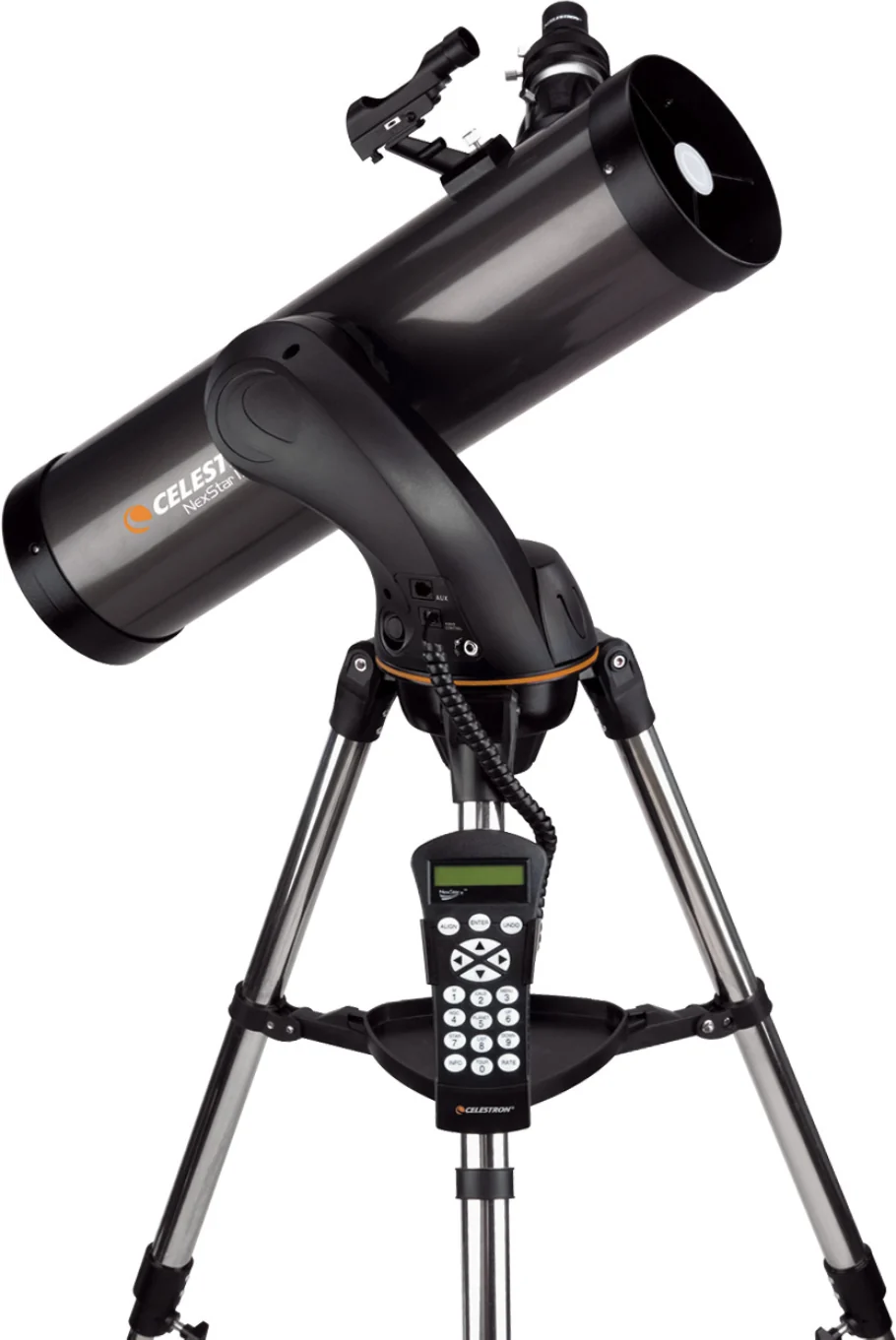
Based on owner reports and hands-on reviews, Celestron NexStar 130 SLT is hard-to-use, expensive, and full of flaws. The quality of the optical tube and the 2” focuser are the only compensations.
Pros
- All-rounder Optics
- Auto-Tracking
- GoTo Capabilities
- 2" Focuser
Cons
- Wobbly Base
- No Built-in Battery
- GoTo Mount is not perfectly reliable
- Cheap Eyepieces
Available at These Vendors
Review
Budget digital telescopes are always hard to pull off. They are not bad choices if the optical tube is a small Maksutov. But Celestron NexStar 130 SLT rocks a 130mm-650mm optical tube. You have to supply it with a sturdy mount, or the whole experience is ruined, which is the problem with NexStar 130 SLT.
The other major problem is the lack of a built-in battery, which we will talk about in the “NexStar Mount” section.
Overall, NexStar 130 SLT is not a good choice; however you slice it. It is too expensive to have major flaws.
Owners report the NexStar Mount can’t carry the optical tube.
Optics
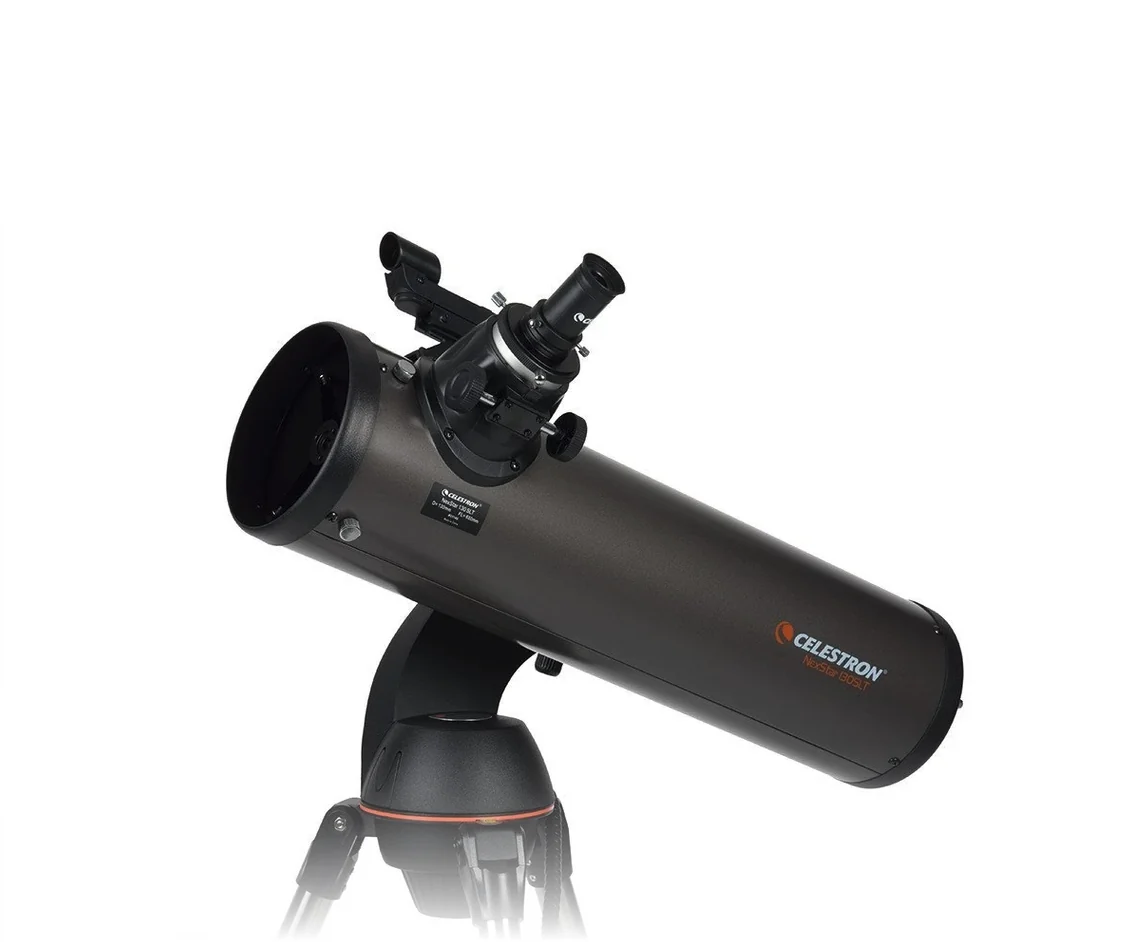
The optics slightly lean towards deep space performance.
The optical tube is a 130mm reflector with an f/5 focal ratio. Although it is great for deep space viewing, owners report planetary performance is pretty good as well.
The usual reflector problems exist with NexStar 130 SLT’s optical tube as well. It requires precise collimation(alignment), and diffraction spikes are present due to the spider at the optical tube entrance. But these aren’t major problems.
Planetary Performance
130mm aperture is enough for major Solar System details.
According to owner reports, Jupiter’s Stripes, its Galilean moon’s, and The Great Red Spot are easily observable. The images are color accurate due to the parabolic mirror and high-quality coatings. You can get the unique beige and brown color of the storms.
Rings of Saturn and its largest moons are visible. Saturn also shows its unique yellow-green surface color.
Mars and Venus look more like colorful disks instead of spheres. Mars will show some amount of surface detail as black and white stains, and Venus’ Phases are observable.
Mercury, Uranus, Neptune, and Pluto look like colorful tiny dots. They are hard to observe with any telescope.
The Lunar Surface look color accurate with countless craters and mountain ranges. The Moon looks mesmerizing with most telescopes, it is an easy target.
Deep Space Performance
Owners describe deep space performance as awesome due to the f/5 focal ratio and 2” focuser. Celestron aimed for this area in the design.
The usual targets are reported to look phenomenal. Some of these are the Andromeda Galaxy, Orion Nebula, Pleiades Star Cluster, and Hercules. They show tiny stars around the objects. The field view is so wide it can fit in the largest of deep space objects.
The 2” focuser enhances the deep space observations.
Of course, if you go higher in aperture, you will get better deep space performance. But for a 130mm telescope, you can’t expect anything better.
Is Astrophotography possible with Celestron NexStar 130 SLT?
No. Serious astrophotography is not possible with Celestron NexStar 130 SLT. The problem is the altazimuth nature of the mount. It moves in an up-down motion. For long-exposure astrophotography, you need an equatorial mount. Such mounts are ridiculously expensive.
But, owners report it is possible to get decent 30-40 second exposure images. So below-average planetary photography is achievable. You can get detailed images of Jupiter, Mars, Saturn, The Moon, and Venus. But deep space imaging is difficult with this kind of exposure time.
Long exposure photography is out of the question.
Mount
Owners say the wobbling gets frustrating after a while.
The mount is the most problematic part of Celestron NexStar 130 SLT. It cannot carry the weight of a 650mm optical tube. Owners report the wobbling starts to get really annoying at high powers.
The Battery Problem
In addition to the minor problems, NexStar 130 SLT doesn’t come with a built-in battery. Tesla is building 400-mile range cars, and Celestron can’t fit a small battery inside the NexStar Mount. This is absolutely ridiculous in this day and age.
Celestron doesn’t send a battery. Yes, you’ve read it right.
There is a slot for 8 AA batteries. This would be acceptable if, as owners report, they didn’t run out in a single night.
You will have to use an external power source, eventually. But this is a burden most of the time, and it may ruin the collimation due to the cable connection.
Is NexStar Mount Reliable?
Owners report the motors inside the mount are reliable most of the time. But, they occasionally break down. In such a case, you can’t solve the problem yourself. You will have to send the telescope to a Celestron Customer Service. This is one of the main reasons why computerized budget mounts are not wise choices.
NexStar Mount works well 99% of the time.
The Software
There are three ways of controlling the optical tube, none of which are ideal.
You can use the Hand Controller, which is antique technology, but reliable.
You can get the Celestron WiFi Adapter and use the SkyPortal App. But owners report the connection is not reliable.
You can use a third-party software, which is always problematic. We don’t recommend this way if you are not going to get into serious astrophotography.
Celestron StarSense
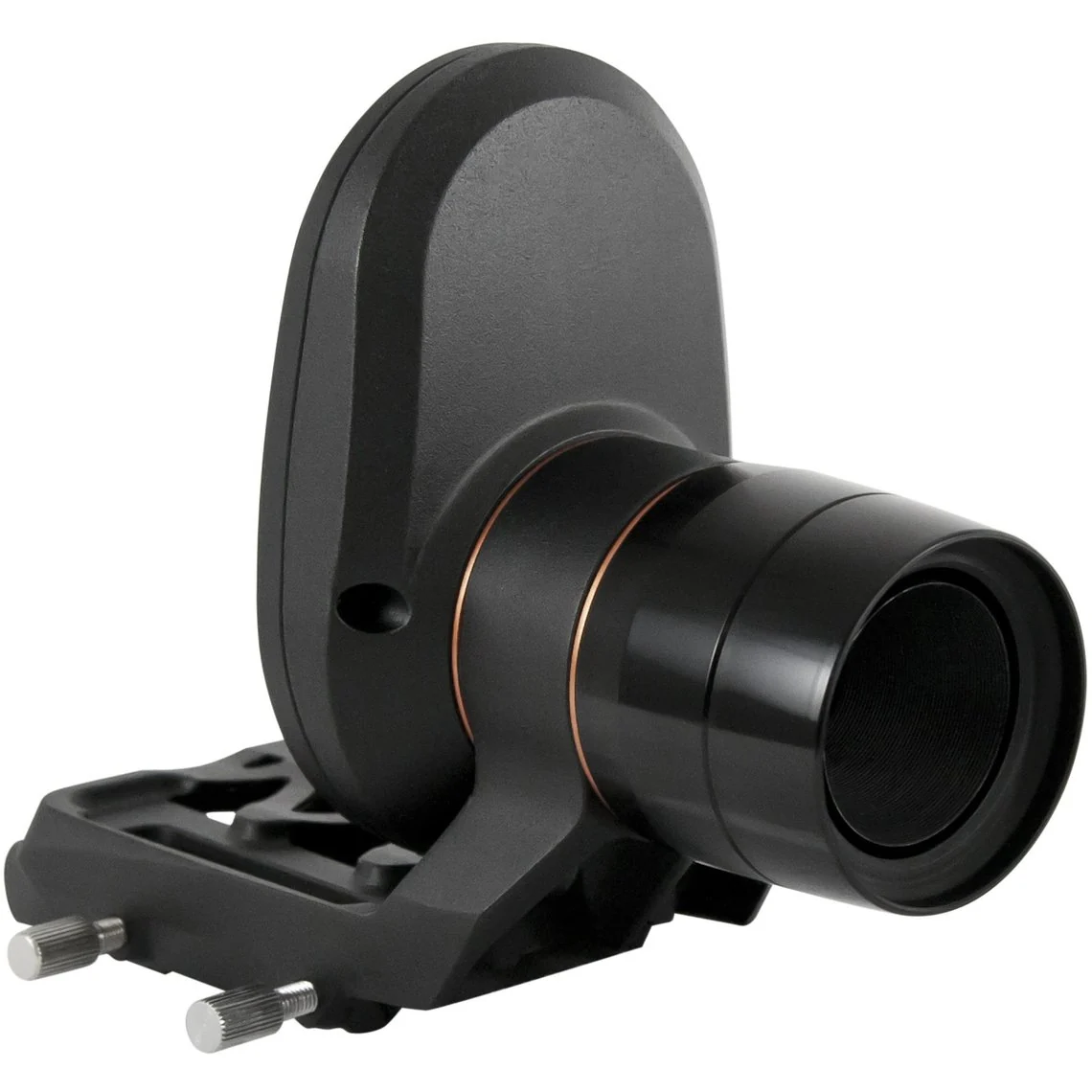
StarSense Camera is a technology Celestron recently came up with. Reviewers call it phenomenal. It auto aligns the telescope. But, it costs nearly as much as the telescope.
Tripod
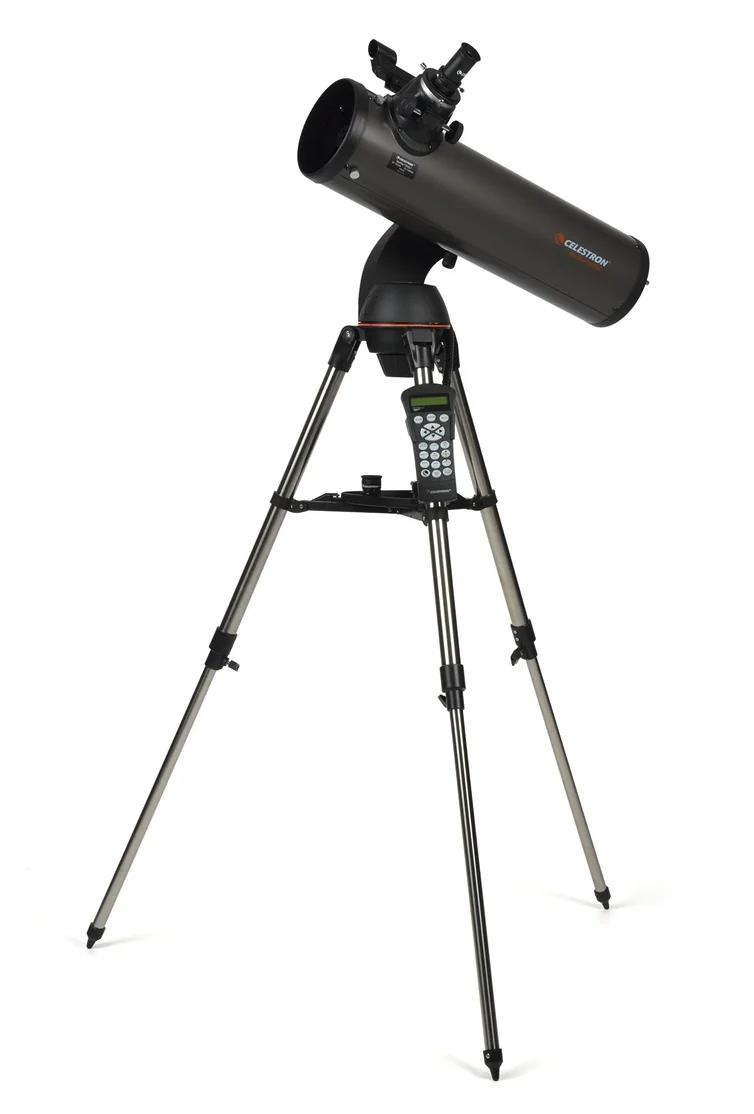
The tripod is steel, but still not enough.
The tripod, like the mount itself, is not strong enough for the 650mm optical tube. Celestron used steel, which is appreciated. But it is a thinned out version to save the cost.
The tripod can carry 90mm Maksutov’s, but it is a no-go for 130mm reflectors such as NexStar 130 SLT.
Accessories
The accessories are not premium, but they are smart choices.
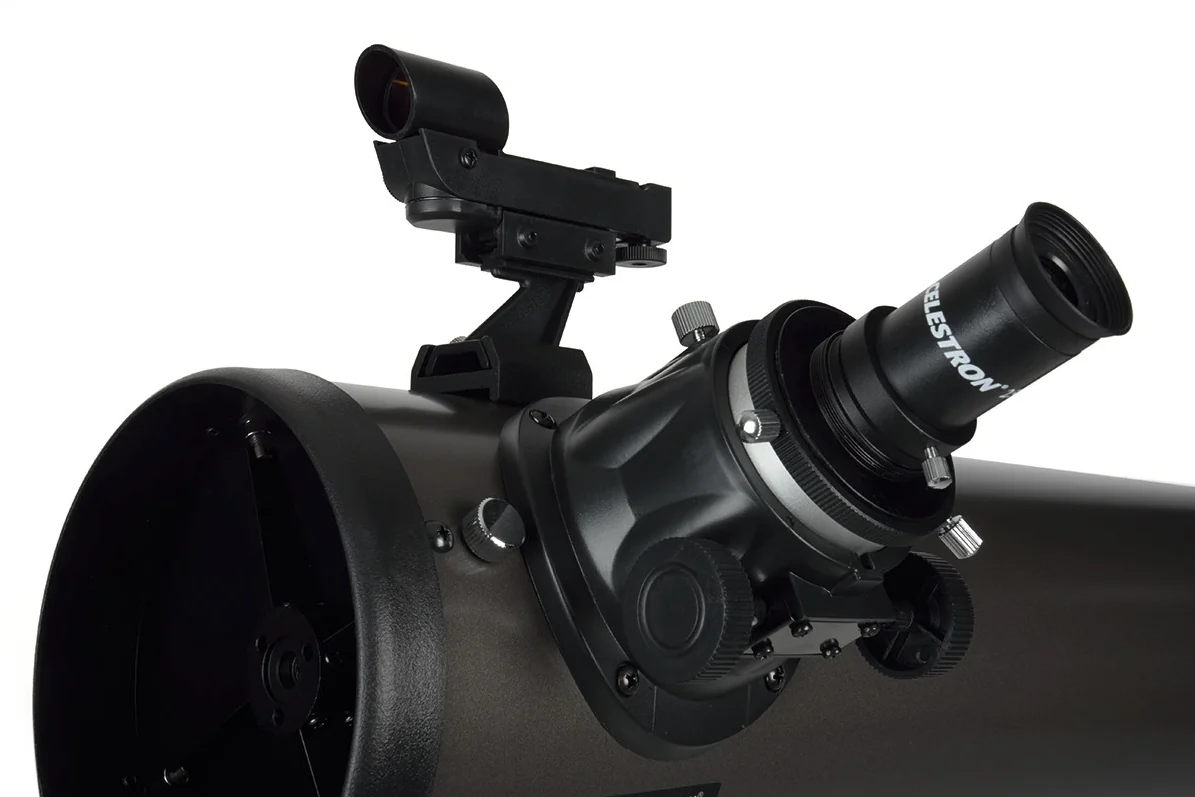
The 2” focuser is rare among 130mm reflectors.
The most significant accessory is the 2” focuser. It opens up a whole world of excellent 2” eyepieces you can use with the telescope.
The rack-and-pinion focuser is plastic on the outside and metal on the inside. We appreciate this decision if it decreases the cost.
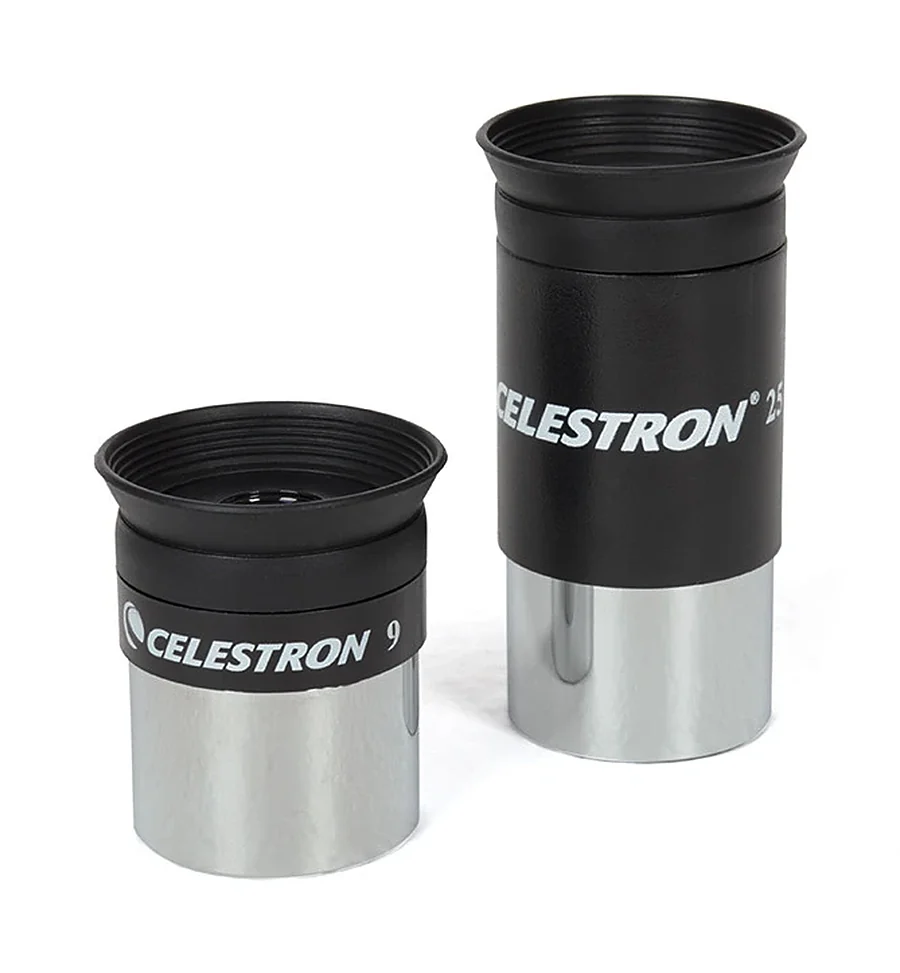
The eyepieces are boring Kellner models. They are as budget as it gets. We suggest replacing them as soon as you can. A 25mm Plössl is a decent starting point.
The star diagonal is ideal for astronomy. In contrast to the usual “Amici” models, Star Diagonals don’t decrease image quality. Like the 2” Focuser, it is a smart accessory to send with a telescope.
The finder is a red dot model. It is also a cheap choice like the eyepieces, but you will only use them when first aligning the telescope. So this is not a huge deal.
Drawbacks
The optical tube is too heavy for both the tripod and the computerized mount.
There is no built-in battery, and owners report the AA batteries don’t last a long night. An external power source is necessary.
The computerized mount is not as reliable as manual mounts.
Conclusion
Celestron NexStar 130 SLT is hard to recommend. Although it has phenomenal deep space performance, if you can’t support this with a high-quality mount, there is no point. The NexStar Mount has the technology of the 2000s.
We recommend getting a manual telescope at this price range. With budget computerized telescopes, most of the cost goes to the computer.
A Z8 is the best telescope that you can get for the same price. If portability is vital, StarBlast 6 and Z130 are phenomenal choices.
Disclaimer: This review is based on official specifications, owner reports, and independent reviews. We have not personally tested the Celestron NexStar 130 SLT, but we’ve gathered information from multiple trusted sources to provide a fair and accurate summary.